
I Have Prayed For You
Part IV: The Bitter Weeping of Peter: A Soul in Conflict

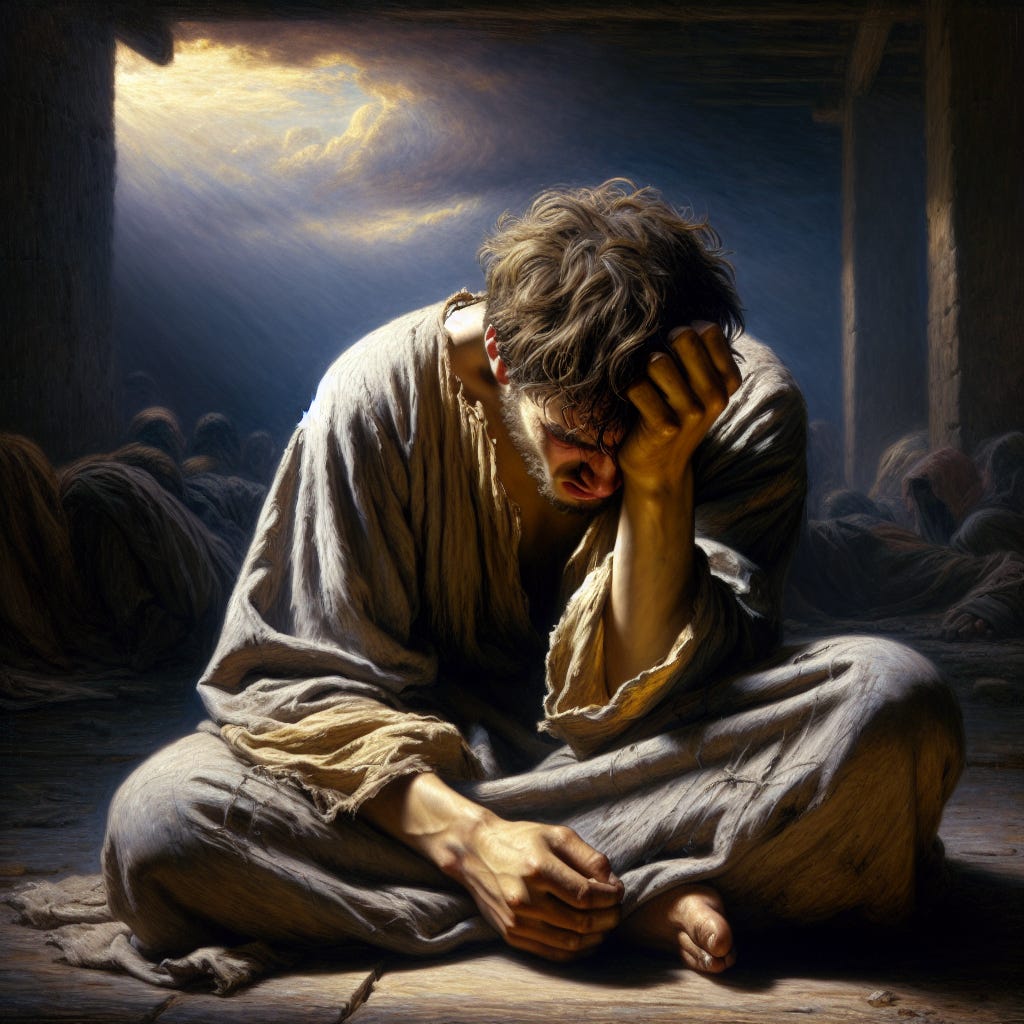
Then the Lord turned and looked at Peter. So, Peter remembered the word of the Lord, how he had said to him, “Before the rooster crows today, you will deny me three times.” And he went outside and wept bitterly. (Luke 22:54–62)
As Peter steps outside into the darkness, the weight of his denial presses down upon him. The sound of the rooster's crow has cut through his bravado and self-assurance, exposing the deep fracture in his soul. "And he went outside and wept bitterly"—this is no simple sorrow. The Greek word "πικρῶς" (bitterly)[1] suggests an intensity of grief that is far beyond mere regret; it speaks to the anguish of a soul confronting its own failure at the deepest level.
The Deep Wound of Denial
Peter’s weeping is not just for the pain of what he has done but for what his actions reveal about him. His denial is a mirror, showing him how far he has fallen from the idealized image of himself—a man of courage, a leader among the disciples, the one who swore, “I’m ready to go with you both to prison and to death.” (Luke 22:33). His denial, a total reversal of that pledge, shatters his perceived sense of self (however imperfect that sense of self is). Peter is confronted not only with the depth of his betrayal but also with the truth of his own vulnerability and weakness. This is a bitter sorrow because it unmasks the very fears and insecurities Peter has spent his life trying to control. Be ever mindful that long before Jesus utters the words, 'Thou art Peter, and upon this rock…' (Matthew 16:18), He signals—at their very first encounter—that a deep work of integration is going to take place in Peter’s life. When Jesus first meets him, He says, 'You are Cephas' (which is translated Peter – John 1:42), indicating who Peter is truly intended to be and become.
The journey from being to becoming (from Simon to Peter) is a lifelong process of participating inwardly and outwardly in the Spirit of Christ. Like Peter, all of us discover that certain aspects of this integrative journey unfold slowly, often unevenly, as the Spirit patiently heals, shapes, and transforms us from within. Yet this slower work—often hidden, frequently painful—is not a flaw in our formation but rather essential to it. Those places within us that remain stubbornly resistant or incomplete become sacred spaces where God's grace engages us most deeply revealing that integration is not merely about becoming whole in a neat, linear progression, but about being faithfully met by Christ precisely in those unresolved tensions and fragmentations. Peter's story assures us that the Spirit’s work of healing and integration ultimately leads not just to a restored self-image but to a deepened capacity for compassion, humility, and authentic strength forged through our vulnerability and dependence upon Christ.
The Fear Beneath the Denial
Peter’s internal dynamics are shaped by fear—fear of suffering, fear of rejection, fear of failure. These are not new emotions for Peter. He has wrestled with them before, but they have been masked by his brash confidence and impulsive actions. Now, in the shadow of the cross, with Jesus arrested and vulnerable, Peter’s bravado crumbles. The fear of association with Jesus in his weakest moment paralyzes him. This fear leads to a self-protective response: denial. Yet, it is this very fear—this refusal to face vulnerability—that makes the weeping so bitter. It is a confrontation not just with what Peter has done, but with who he has become in his attempt to shield himself from the discomfort of identification with Christ.
The Pain of Self-Betrayal
Peter’s weeping is also a weeping over his own betrayal of himself. As he denies Jesus, he is denying the person he once believed himself to be—the one who would stand by Jesus no matter the cost. This internal fracture—the split between what he desired to be and what he actually was in the moment—creates a bitterness that goes deeper than regret. It touches the very core of Peter’s identity. In that moment, the provisional self he had crafted—bold, loyal, fearless—collapses. Like so many of us, Peter had formed a self-image to live up to, a persona that could mask the vulnerabilities and fears he dared not name. These masks, these constructed selves, are not always ill-intentioned; they can help us function, even aspire. But in crisis, they often fail us. They cannot shield us from the searing truth of our contradictions. Peter’s grief is so penetrating because it is not merely sorrow over an external act; it is the anguish of a man watching the scaffolding of his selfhood give way under the weight of his unacknowledged fear. And yet, he has no clue that this grief—raw, disorienting, and humiliating—is a gift in disguise. It is undoing him in order to remake him. Though he cannot see it yet, this sorrow is not his end, but the beginning of a deeper, truer becoming.
Peter’s Denial and the Scapegoat Mechanism: A Path to Restoration
As the night falls and the weight of what is unfolding presses in on Peter, his world begins to unravel. He is faced with a harrowing choice: to stand with Jesus, who has been condemned, or to protect himself from the chaos and danger surrounding Him. The violence is escalating, and the risks are mounting. Peter, a man who has pledged his unwavering loyalty, finds himself in a moment of unbearable pressure. When questioned about his association with Jesus, he denies it—not once, but three times.
Rene Girard’s scapegoat mechanism offers a compelling lens to understand Peter’s actions. The scapegoat mechanism, as Girard describes it, is a psychological and social process by which a community channels its collective violence onto a single individual, the “scapegoat.” This victim is blamed for the community’s ills, and through their rejection or sacrifice, the community believes it can restore order and peace. In the case of Jesus, the community has already chosen Him as the scapegoat, condemning Him to die. Peter, witnessing this, becomes gripped by the instinct to survive and align himself with the crowd, distancing himself from the one marked for persecution. By denying Jesus, Peter is acting out of self-preservation, reflecting the dynamics of the scapegoat mechanism Girard so vividly describes.
When we read the story of Jesus’s Passion, we often picture the frenzied crowd demanding His crucifixion and wonder how the mood turned so swiftly against Him. René Girard, in The Scapegoat, helps us see that beneath this volatility lies a timeless mechanism of persecution. As he puts it, “the control exercised by persecutors and their accounts of persecution … are at stake”[2]. The crowd, anxious and in search of someone to blame, seizes upon Jesus with what Girard describes as “vague accusations,” transforming Him into the supposed source of disorder—a convenient “invisible prison”in which a victim is singled out to bear collective guilt[3].
This phenomenon, Girard argues, is the scapegoat mechanism at work, and it casts Jesus as “taken for a criminal” (Luke 22:37) precisely because the people “always believe in the excellence of their cause” yet are, in truth, hating “without a cause”[4] . The Gospels, however, “deny … stereotyped accusations” and refuse “the cruel illusions of these cruel crowds”[5]. In other words, while the majority wants to pin society’s unrest on Jesus, the Gospel writers show us that He is not the guilty one at all. He is the innocent victim around whom collective fear and false accusations coagulate. As a result, the very moment Jesus is scapegoated, the deeper logic of scapegoating itself begins to come undone.
Into this scene stepped Peter, warming himself by a fire while his beloved Master stood wrongly accused. We often regard Peter’s denial as simple human frailty—his fear of arrest or ridicule. Girard sharpens that understanding: Peter was also terrified of identifying with the scapegoat. Having witnessed the crowd’s swift turn, he sensed their collective impulse and fears that if he remained loyal to Jesus, he would more than likely, share His fate. Girard points out that persecuting crowds will “resort to [magical thinking] at the first sign of disorder”[6]: once the community latched onto an alleged “cause” for its troubles, anyone associated with that cause was equally at risk. This is why Peter reflexively said, “I do not know him” (Luke 22:57). It was the survival reflex of a disciple who realized that standing with the scapegoat threatened to make him the next victim.
Yet the Gospels also reveal a remarkable reversal. Far from hiding the victim’s innocence, as so many myths do, they highlight that Christ is the Suffering Servant of Isaiah 53—He carries our brokenness not because He is truly guilty but because the crowd must channel its fear and blame somewhere. And even as Jesus is “taken for a criminal” (Luke 22:37; Mark 15:28), His innocence becomes glaringly apparent[7].
Peter’s denial is not just about self-preservation—it’s an attempt to avoid being cast out. The fear of being associated with Jesus, now the outcast and the condemned, is paralyzing. Peter recognizes that to stand with Jesus would mean identifying with a person rejected by society, marked as guilty by the very system that once embraced Him. Just as the community expels the scapegoat to maintain social order, Peter rejects Jesus to avoid becoming the next victim, the next scapegoat. His fear of persecution and exclusion drives him to deny Jesus—he does not want to become like the one condemned to death. René Girard illuminates this reality clearly:
“Persecutors always believe in the excellence of their cause, but in reality they hate without a cause. The absence of cause in the accusation (ad causam) is never seen by the persecutors.”[8].
Peter senses this unconscious, irrational hatred at work and seeks desperately to distance himself from becoming its target.
In the heat of the moment, Peter’s fear becomes so intense that he is swept along by the same collective anxiety that others around him feel. Mimetic desire[9], a term Girard uses to describe how people unconsciously imitate the desires and actions of those around them, plays a role in Peter’s denial. As he sees others reject Jesus, he mimics their behavior in an attempt to fit in, to escape the inevitable fallout. His actions reflect a pattern of mimetic rivalry[10], where his desire to avoid being the scapegoat leads him to replicate the crowd’s rejection of Jesus.
But in the quiet aftermath, Peter’s heart is shattered. After the third denial, the rooster crows, and Jesus' words—"Before the rooster crows today, you will deny me three times"— loudly ring in Peter’s mind. The reality of his betrayal sinks in, and he is overcome with grief. His bitter weeping is not just an expression of personal guilt; it is the recognition that he has, in some way, participated in the very scapegoating process that condemns Jesus. Peter's weeping reflects a moment of recognition—he is confronted with his own participation in violence, albeit a spiritual and psychological form, that mirrors the act of casting out the very one who was innocent.
When Luke tells us that Peter “went out and wept bitterly” (Luke 22:62), we instinctively sense that something deeper is happening than simply leaving a courtyard or a crowd gathered around a fire. Peter is not merely stepping away from accusing faces and painful questions—he is stepping into a darkness within himself. Where does he go in this moment? Physically, we don’t fully know, but inwardly, he is crossing into a kind of wilderness where familiar landmarks have vanished. In that moment, Peter is alone, not only in body but in soul.
Peter’s bitter weeping reveals a depth of despair that goes beyond regret or simple sorrow. It’s the weeping of someone whose entire world has shattered—whose sense of himself has cracked wide open. It is as if Peter, in these tears, is losing himself entirely, unsure whether he’ll ever find himself again. Perhaps some of us have felt something similar—a moment when our inner world collapses, and we feel utterly lost, a dizziness of spirit that makes the familiar suddenly strange and terrifying.
Kierkegaard names this kind of despair in stark, uncompromising terms:
“The despairing person understands his despair as a suffering—instead of its being a guilt. This belongs so essentially to all despair...that it is a sign of healing and the beginning of deliverance if the despairing person learns to understand this differently.”[11]
Peter feels his despair as pure pain, as though something unbearable is being done to him. He senses it as a crushing weight from outside, when it actually comes from deep within his own broken heart. Kierkegaard confronts this directly:
“A person thus afflicted often complains that something has fallen upon him, that it is as if he had a weight to bear, etc. This pressure, this weight, is not anything external; it is...a nervous delusion, it is an inverse reflection of something internal; the sufferer feels an inward pressure as something external. It is the same with despair.”[12]
Peter, in his bitter tears, may indeed feel this heavy weight, believing himself crushed by unbearable pressures around him. But in truth, the weight is completely within...it is precisely his own anguish, guilt, and the deep fracture between who he wanted to be and who he has become. It is painful because it’s personal, deeply internal, a pain Peter himself has unknowingly helped to create.
Kierkegaard further sharpens this understanding of despair:
“The human being as spirit simply cannot have equilibrium in himself... Only by the relation to this other can he be in equilibrium. As soon as there is a misrelation in the relation, there is despair.”[13]
Peter’s bitter weeping is the sound of despair—raw, unfiltered, and consuming. It is not merely sorrow or disappointment; despair is far darker. James Hollis names it bluntly:
“Despair is to be without hope, without prospects, without alternatives. In the Judeo-Christian tradition, despair is a sin for it infringes on God’s autonomy, limits the Limitless, constricts the Creator. In many ways, despair may be seen as the worst of the dismal states for it seems to offer no way out.”[14]
Peter isn’t merely feeling sadness or disappointment, Hollis bids us realize that when given thought to his insight, that Peter is indeed caught in the grip of despair. While Hollis makes a sweeping statement about despair being sin, it was in fact in later Christian thought that despair came to be regarded as a sin, not because it represents simple moral weakness, but because it reflects the deep and painful loss of hope, a loss so intense that it denies, perhaps without meaning to, God’s capacity to restore and forgive.
Yet long before despair was explicitly named as sin, the early Church understood such experiences primarily as spiritual suffering, often described as acedia. Michael Downey explains this ancient condition clearly:
“Acedia…is the lack of commitment to spiritual values, or carelessness, listlessness, unconcern”.[15]
Early Christian monks like Evagrius Ponticus, John Cassian, and John Climacus wrote at length about acedia, seeing it not merely as a flaw in character but as a spiritual state marked by emptiness and weighty dissatisfaction. Gregory the Great, including acedia under the category of “sadness (tristitia),”identified it among the seven deadly sins, highlighting how deeply destructive and pervasive it could be.[16]
Peter’s moment in at this point in his pain echoes something of this spiritual condition: he is cut off, not only from the community around the fire, but inwardly isolated, struggling with excessive discouragement and detachment. Downey describes this vividly, saying that acedia is
“caused by a failure to appropriate the values of the group or its lifestyle, resulting in an inability to identify with the group and a strong inclination to stand apart from it”.[17]
Is this not precisely Peter’s situation in this moment? Does he honestly any longer sees himself as part of the community he once embraced wholeheartedly? His denial is powerful enough to create something quite close it would seem to a permanent state of separation, not only from Jesus and his fellow companions, but also from the very values that once defined him.
The greater question we need to wrestle with is whether we recognize something of ourselves here as well? What of those times when we feel inwardly detached, drifting away from what we once deeply valued? Downey notes that acedia is marked by behaviors such as
“escapist activities…a shortened attention span…making it impossible to concentrate on any particular task and bring it to completion”.[18]
All of us, to one degree or another, understand that kind of restless inner wandering, avoiding challenges, seeking distraction, yet never finding satisfaction. If left unattended, spiritual detachment like that can spiral deeper into depression and isolation.
When we look carefully at Peter’s bitter tears, we see not just sorrow, but a deep and wrenching realization of personal failure. His tears reveal the stark reality that he has done something unimaginable, unthinkable—he has effectively committed the same betrayal as Judas, turning his back on the one he had vowed to follow, even unto death. But unlike Judas, whose despair drove him deeper into isolation, Peter’s anguish contains within it something more complicated—somewhere, faintly echoing deep within his troubled psyche, remains the whisper of a promise spoken by Jesus himself: “I have prayed for you...” (Luke 22:32). Surely, even now, when Peter cannot yet fathom a way out of his pain, these quiet words must count for something. They linger, unseen and scarcely believed, like seeds waiting quietly in the darkness. The ancient monks who first named this condition also offered compassionate pathways out of it. Downey notes their traditional remedy:
“a healthy alternation between prayer and work… Attending to the needs of others and serving the community were also seen as ways of overcoming a preoccupation with self”.[19]
But Peter isn’t yet ready to face the full weight of this promise. Instead, soon after, Peter will attempt to return to what he knew best: fishing. In his inner confusion, Peter will choose a familiar escape route rather than confronting the uncomfortable truth of his deeper calling. He will decide, perhaps with a kind of numbness, “I am going fishing” (John 21:3). This isn't a casual decision. Peter is, in fact, exerting the very leadership he fears he has forfeited. His decision will influence six others—disciples of Jesus—to join him, following him backward, away from Jerusalem, away from their calling, away from the pain of facing themselves. Peter’s choice may feel comforting at first, but it leads nowhere fruitful. This escape to the familiar is exactly the wrong direction.
Peter’s inner turmoil and deep despair, as James Hollis described it, is precisely this loss of hope and direction, a painful belief that no pathway forward exists. Here sits Peter, seemingly without hope, without prospects, without alternatives. Yet in the torment of his weeping, this first among equals has momentarily forgotten that the God who called him cannot be constrained by human failure. Yet the echo of Jesus’ promise, “I have prayed for you”, persists, even beneath his despair.
Gerard Manley Hopkins captures something of the sheer and terrifying quality of this inner experience:
“O the mind, mind has mountains; cliffs of fall
Frightful, sheer, no-man-fathomed. Hold them cheap
May who ne’er hung there.”[20]
Peter’s despair is exactly this: a sheer cliff, terrifying and unfathomable, with nothing to hold onto. Those who've never stood at the edge of such a personal abyss might easily dismiss Peter’s tears as mere regret or momentary sadness. But Hopkins reminds us that no one truly understands the frightful depth of this despair except those who have felt themselves hanging there, suspended helplessly above an inner darkness.
Peter, in his anguished tears, now hangs precisely at this place—overwhelmed by his betrayal, lost in a landscape that feels impossible to navigate. If we’ve ever stood near the edge of our own despair, we recognize something of ourselves here, a sobering truth that cautions us against casually dismissing Peter’s struggle or anyone else’s.
Yet even here, in the harrowing uncertainty of his despair, Peter stands at a threshold—though he cannot yet see it clearly—where the faint echo of Jesus’ prayer can begin to resonate once more. Before the charcoal fire that Jesus himself will soon prepare, before Peter can be fully restored to his true calling, he must first wrestle with this inner turmoil, with the depth of his own confusion and the stark reality of his denial. The road ahead will not be easy, but even now, a gentle hope—rooted not in Peter’s faithfulness, but in Jesus’ unyielding grace—remains quietly alive, waiting patiently until Peter is ready to embrace it.
The ancient monks who first named this condition also offered compassionate pathways out of it. Downey notes their traditional remedy:
“a healthy alternation between prayer and work… Attending to the needs of others and serving the community were also seen as ways of overcoming a preoccupation with self”.[21]
In the next installment, we find ourselves at another charcoal fire—one prepared by Jesus himself on the shore. Here, Peter, weary from fishing all night with nothing to show for it, will once again face the Lord he denied. Yet rather than judgment or rejection, Peter will encounter something altogether unexpected: an invitation to breakfast, and with it, the gentle, unyielding insistence that he finally confront the truth of his own heart. At this second fire, Peter’s story—and ours—moves beyond despair, pointing toward a grace strong enough to restore even the most broken of us.
[1] πικρῶς: pertaining to feeling mental agony—‘bitterly, with agony.’ ἐξελθὼν ἔξω ἔκλαυσεν πικρῶς ‘he went out and wept bitterly’ Mt 26:75. Johannes P. Louw and Eugene Albert Nida, Greek-English Lexicon of the New Testament: Based on Semantic Domains (New York: United Bible Societies, 1996), 318.
[2] Rene Girard. The Scapegoat, Johns Hopkins University Press, 1986, Chapter 9, p. 102
[3] Ibid., pp. 102-103.
[4] Ibid., p. 103.
[5] Ibid., p. 102.
[6] Ibid. p. 102.
[7] Ibid., p. 102.
ibid., p. 103.
[9] Ibid. Chapter 5, p.64.
[10] Ibid. p. 63.
[11] Søren Kierkegaard, The Sickness unto Death, trans. Howard V. Hong and Edna H. Hong, Princeton: Princeton University Press, 1980, pp. 145–146.
12 Ibid. p. 145.
13 Søren Kierkegaard, The Sickness unto Death, trans. Howard V. Hong and Edna H. Hong, Princeton: Princeton University Press, 1980, pp. 145–146
14 James Hollis, Swamplands of the Soul: New Life in Dismal Places, Toronto: Inner City Books, 1886, pp. 90–91.
15 Michael Downey, The New Dictionary of Catholic Spirituality (Collegeville, MN: Liturgical Press, 2000), 4.
16 Ibid. p. 4.
17 Ibid. p. 4.
18 Ibid. p. 4
19 ibid. p. 4.
20 Gerald Manley Hopkins. “No worst, there is none. Pitch past pitch of grief.” https://www.poetryfoundation.org/poems/44398/no-worst-there-is-none-pitched-past-pitch-of-grief
Thanks Dr. Chironna.
This is beautiful and strikes deep